

India Gains Ground as Global Smartphone Manufacturing Hub
Strong export growth and policy support push domestic manufacturers to the forefront as global brands deepen local partnerships and shift production strategies toward India’s expanding electronics ecosystem
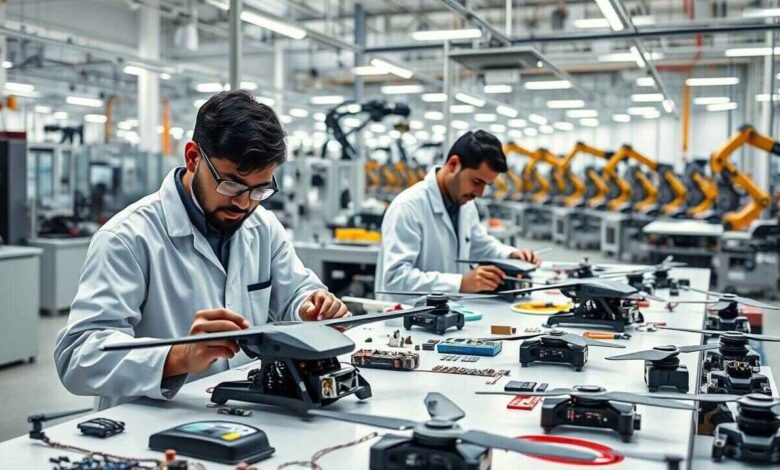
India’s position in the global smartphone manufacturing landscape is strengthening rapidly, driven by a combination of policy incentives, export momentum, and growing participation from domestic contract manufacturers. Recent industry data shows that nearly one in every four smartphones produced in the country is now made by local contract manufacturing firms, marking a significant shift in the electronics ecosystem.
This transformation has been fueled by increased outsourcing from global smartphone brands. Companies such as Motorola, Realme, and Xiaomi are increasingly relying on Indian partners for production, highlighting a broader industry trend toward localized manufacturing.
At the center of this growth is Dixon Technologies, which has emerged as the country’s largest device maker. The company recorded a remarkable surge in production, achieving an 89 percent increase and capturing a 19 percent share in the electronics manufacturing services segment. In 2025, it even surpassed Samsung Electronics in total production volume within India.
Meanwhile, global manufacturing giant Foxconn secured the second position with a 16 percent share, largely driven by export shipments linked to Apple. Samsung, despite its scale, slipped to an 18 percent share due to slower export growth compared to its competitors.


Another notable entrant in the top tier is Bhagwati Products, a joint venture involving Micromax Informatics and China’s Huaqin Technology. With a 9 percent market share, the company has benefited from contracts with brands like Vivo and Oppo, reflecting how Chinese firms are restructuring supply chains and strengthening local collaborations in India.
Industry analysts point out that the surge in outsourcing by Vivo and Oppo around 2024 played a crucial role in boosting domestic production volumes. These partnerships allowed Indian manufacturers to scale quickly, leveraging existing global supply chain networks and expertise brought in through collaborations.
Government policies have also played a pivotal role. Production-linked incentive schemes and relaxed foreign investment norms have encouraged both domestic and international players to expand operations in India. In 2025, smartphone manufacturing in the country grew by 8 percent overall, with exports rising sharply by 28 percent. Exports now account for nearly one-third of total production, while domestic demand has remained relatively stable with modest growth.
However, the road ahead is not without challenges. Analysts warn that global uncertainties, including potential geopolitical tensions such as a US-Iran conflict, could disrupt logistics and supply chains. Additionally, rising memory chip prices may put pressure on demand in the long term.
As the current incentive cycle nears its end, companies are also reassessing cost structures and partnerships, leading to a redistribution of manufacturing volumes. A portion of this shift is expected to favor established domestic players like Dixon Technologies.
Looking ahead to 2026, exports are projected to remain the primary growth driver for India’s smartphone manufacturing sector. With increasing global reliance on Indian facilities, smartphones are set to play a central role in advancing the country’s broader electronics industry ambitions.