Taxation Without Representation? The Southern States’ Federal Anxiety
Tamil Nadu, Kerala, Karnataka, Telangana and Andhra Pradesh approached the 16th Finance Commission with memoranda that were strikingly convergent in diagnosis, even if framed in different idioms.
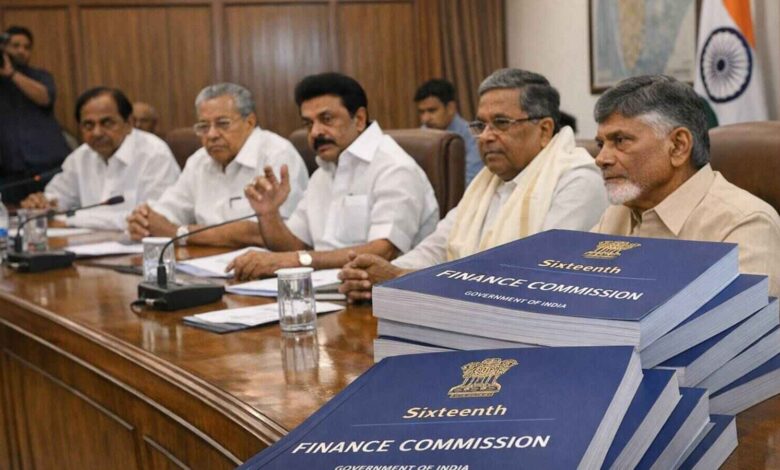
The Sixteenth Finance Commission has not redrawn India’s fiscal map, but it has confirmed, with unusual clarity, the structural bargain that underpins it: states that controlled population growth, expanded formal economic activity and generated a disproportionate share of national revenues will continue to finance the Union, while redistribution remains anchored to demographic scale rather than economic contribution—just as political representation itself is poised to tilt further in the same direction. Read alongside what the southern states collectively submitted to the Commission, the award is less a neutral technocratic exercise than a quiet affirmation of where power, money and voice are now expected to reside.
Tamil Nadu, Kerala, Karnataka, Telangana and Andhra Pradesh approached the 16th Finance Commission with memoranda that were strikingly convergent in diagnosis, even if framed in different idioms. All argued that India’s fiscal federal architecture has failed to adjust to demographic transition; that population control has become a long-term fiscal penalty rather than a dividend; that indirect tax contribution, tax effort and compliance are systematically undervalued; and that the expanding use of cesses and surcharges has hollowed out the promise of the 41 per cent devolution headline. None asked for the dismantling of redistribution. All asked for recognition that redistribution cannot become a permanent extraction mechanism from a shrinking set of contributor states.
The Commission listened. It made limited adjustments. It did not alter the underlying logic.
The macro arithmetic explains why the southern grievance refuses to dissipate. The five southern states together account for around 30 per cent of India’s GDP while housing just over 18 per cent of its population. Their share in direct taxes, GST collections, exports, formal employment and services output is consistently higher than their demographic weight. By contrast, the large northern and central states—Uttar Pradesh, Bihar, Madhya Pradesh, Rajasthan and Jharkhand—account for over 40 per cent of the population but less than 30 per cent of GDP, and remain heavily dependent on fiscal transfers to finance even routine expenditure.


This divergence is not new; what is new is that it is now demographically locked in. Fertility rates in the South fell below replacement decades ago, while population growth in much of the Hindi heartland remained elevated well into the 2010s. Southern memoranda repeatedly warned the Commission that continuing to privilege population metrics under these conditions would institutionalise a permanent fiscal asymmetry—rewarding demographic lag while penalising demographic discipline.
Yet population remains central. Under the 16th Finance Commission’s horizontal devolution formula, population (2011) and demographic performance together carry 27.5 per cent weight, while income distance retains a dominant 45 per cent. Against this, the long-demanded recognition of contribution arrives in the form of a 10 per cent weight for “contribution to GDP”—a concession that looks significant on paper but functions more as an adjustment at the margin than a rebalancing of priorities.
The distributional outcomes reflect this imbalance. Karnataka emerges as the largest gainer, with its share rising from 3.65 per cent to 4.13 per cent, translating into an additional ₹7,387 crore over five years. Kerala’s share increases from 1.93 per cent to 2.38 per cent, yielding about ₹6,975 crore. Tamil Nadu’s gains are modest; Telangana and Andhra Pradesh see limited improvement. Politically, these increases are showcased as evidence that contributor states have been “heard”.
Economically, they barely scratch the surface.
Even after the revision, Karnataka—responsible for close to 9 per cent of national GDP and a far higher share of direct taxes—receives just over 4 per cent of the divisible pool. Tamil Nadu and Kerala continue to receive well under ₹1 for every ₹1 they contribute to the Union exchequer. Estimates place the return ratio at ₹0.50–₹0.70 for the larger southern states, compared to ₹2–₹3 for several northern and central states. These are not rhetorical constructs; they emerge directly from juxtaposing state-wise tax contribution estimates with Finance Commission devolution tables.
Southern memoranda were explicit about this asymmetry. Tamil Nadu argued that redistribution had ceased to be transitional and had instead hardened into a permanent cross-subsidy, with little evidence of convergence in productivity or governance outcomes. Kerala highlighted demographic ageing as a fiscal stress that the formula refuses to recognise, even as health and pension costs rise inexorably. Karnataka and Telangana emphasised tax effort and compliance, pointing out that states generating buoyant revenues through formalisation are effectively financing both redistribution and the Centre’s own fiscal expansion.
On this last point, the memoranda were particularly blunt. All southern states flagged the explosion of cesses and surcharges, now accounting for close to 20 per cent of gross tax revenues, as the single largest erosion of fiscal federalism. Because these levies sit outside the divisible pool, the effective share of states has declined sharply even as the nominal devolution percentage remains fixed at 41 per cent. In effect, contributor states pay into a tax system from which a growing share is never shared back, while expenditure responsibilities continue to be pushed downward.
The 16th Finance Commission acknowledges this trend. It does not correct it.
The expenditure side compounds the tension. Southern states spend more—both per capita and as a share of GSDP—on health, education, urban infrastructure and social protection, reflecting higher expectations, older populations and denser urbanisation. They also tend to perform better on fiscal discipline metrics, with lower debt stress relative to output and greater transparency. Yet the Commission’s recommendations on borrowing remain uniform: a 3 per cent of GSDP deficit ceiling, tighter scrutiny of off-budget borrowings, and enhanced audit controls, regardless of demographic structure or fiscal capacity.
Here again, the southern argument was clear. Uniform discipline without differentiated autonomy punishes states that invested early in human capital and social outcomes. The Commission’s response is doctrinal rather than contextual.
What turns this fiscal imbalance into a political fault line is the looming question of delimitation. Several southern states explicitly raised concerns—carefully but unmistakably—about the post-2026 reallocation of parliamentary seats based primarily on population. A state that controlled fertility early now faces the prospect of losing political representation, even as it continues to contribute disproportionately to national revenues through both shareable and non-shareable taxes.
The Finance Commission is constitutionally barred from addressing delimitation. But its devolution choices intersect uncomfortably with that future. A federation in which fiscal flows and political voice both tilt towards population-heavy states risks producing a double asymmetry: those who pay more exercise less influence, while those who receive more gain greater representation.
This is the deeper significance of the 16th Finance Commission. Its modest concessions to contribution do not resolve the North–South divide; they manage it. Redistribution remains anchored to demographic scale, while economic geography continues to diverge. The Centre’s fiscal centralisation through cesses further insulates itself from the consequences of this imbalance, even as states compete for shrinking untied resources.
The southern memoranda did not ask for the abandonment of solidarity. They asked whether solidarity could coexist with sustainability—whether a system designed for a young, poor, fast-growing India can adapt to an ageing, uneven, and structurally divergent one. The 16th Finance Commission’s answer, implicit but unmistakable, is continuity.
That continuity may yet prove politically costly. When states that generate growth, comply with fiscal rules and stabilise population are told—implicitly—that their reward is permanent net contribution with diminishing voice, the question ceases to be about formula weights. It becomes a question about the durability of consent in India’s federal bargain.
In that sense, the North–South divide the 16th Finance Commission has laid bare is not merely fiscal. It is about whose choices are honoured, whose outcomes are valued, and whether India’s federal compact can survive a future in which growth pays, population collects, and political power follows numbers rather than contribution.
R. Suryamurthy