

New Study Warns Excessive AI Use May Reduce Critical Thinking and Problem Solving Skills
Researchers from leading global institutions claim overdependence on AI chatbots may slowly weaken independent thinking learning habits creativity and problem solving abilities especially among students and young users worldwide
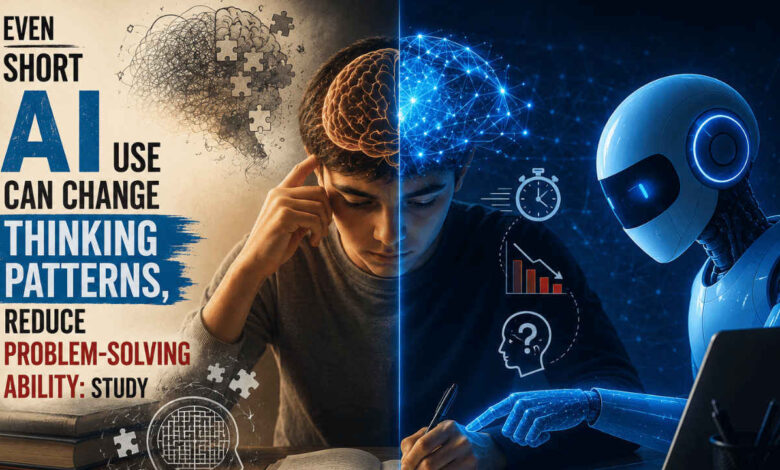
Artificial Intelligence tools are becoming a regular part of everyday life. From completing school assignments to drafting office emails and finding instant answers online, millions of people now rely on platforms like ChatGPT, Gemini and other AI assistants for quick support. While these tools save time and make work easier, a recent study has raised concerns about their long term impact on human thinking abilities.
Researchers from institutions including MIT, Carnegie Mellon, Oxford and UCLA have claimed that even short periods of dependency on AI chatbots could affect how people think and solve problems independently. According to the findings, frequent use of AI for every small task may gradually reduce mental effort and weaken natural problem solving skills.
The study explains that AI provides quick responses, which often discourages users from thinking deeply on their own. Experts compared this behavior to physical inactivity. Just as the body becomes weaker without exercise, the brain may also become less active when people stop challenging it regularly through independent thinking and learning.
Researchers used terms like cognitive laziness and cognitive debt to describe the growing dependence on AI generated answers. These concepts suggest that overreliance on technology can slowly reduce a person’s ability to analyze situations, build logic and think creatively without external assistance.


The concern appears to be greater for students and younger users. Experts believe that if children begin depending entirely on AI for homework, research or learning, they may lose the habit of understanding concepts independently. Over time, this could affect creativity, curiosity and the ability to handle real world challenges without digital support.
Despite the warning, researchers are not asking people to stop using AI completely. Instead, they recommend balanced usage. AI can still be a useful assistant for improving productivity and saving time, but it should not replace personal effort or learning habits. Experts suggest trying to solve questions independently before turning to AI tools for guidance.
The report also encourages people to continue reading books, researching topics on their own and practicing critical thinking regularly. According to experts, keeping the brain active through learning and analysis is important in a world where technology is becoming smarter every day.
Researchers believe AI should ideally help users think better instead of doing all the thinking for them. As AI adoption continues to grow worldwide, discussions around healthy and responsible usage are expected to become even more important in the coming years.