

New Earthquake Control Machine Works Without Electricity and Absorbs Powerful Tremors
Researchers have developed a mechanical earthquake control system using steel spheres that can reduce building vibrations without electricity, offering a low cost safety solution for future infrastructure protection.
Scientists have introduced a new earthquake resistant technology that could change the way buildings and bridges handle powerful tremors. Researchers from the University of Sharjah in the United Arab Emirates have developed a mechanical device designed to absorb earthquake vibrations without depending on electricity, sensors or computer systems. The innovation is being seen as a promising step toward safer infrastructure, especially in regions that frequently face seismic activity.
Unlike advanced electronic safety systems that may fail during blackouts, this newly designed tool works entirely through mechanical motion. That means it can continue functioning even during major earthquakes when power outages are common. Experts believe this simple but practical approach could make the system useful for both developed and developing nations.
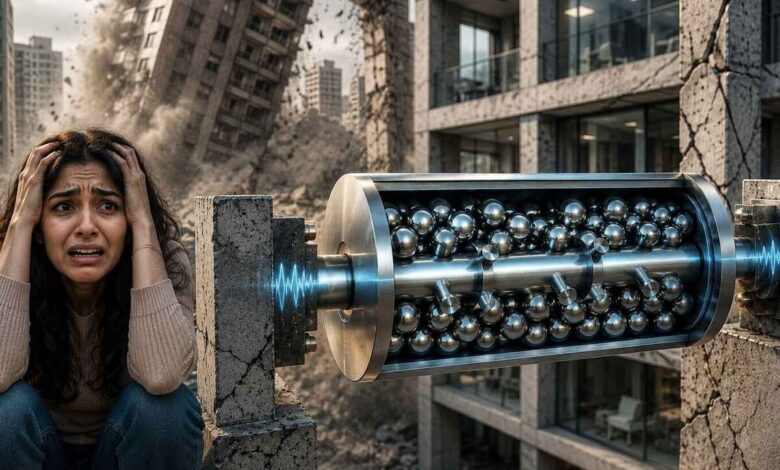
The device, known as a Passive Seismic Damper, has been created to reduce the energy generated when buildings shake during earthquakes or strong vibrations. At first glance, the machine resembles a large steel cylinder. Inside it are several hardened steel spheres along with a moving shaft fitted with smaller rod like structures. The overall mechanism works in a way similar to a vehicle shock absorber, but instead of reducing bumps from roads, it controls seismic energy produced during earthquakes.
Researchers explained that the machine remains inactive during normal conditions. When there is no vibration from earthquakes, strong winds or heavy structural movement, the internal parts stay still and no energy is absorbed. The system only activates when shaking begins.


As soon as seismic vibrations start, the shaft inside the cylinder begins moving rapidly in different directions. The rods attached to the shaft push against the steel spheres packed inside the cylinder. This movement creates intense friction between the spheres and the rods. That friction plays the most important role in the entire process because it converts the dangerous kinetic energy from the earthquake into heat energy.
In simple terms, the machine absorbs a significant portion of the force that would otherwise hit the walls, pillars and foundation of a building. Early testing has shown that the technology can reduce structural vibration and sway by nearly 14 percent, which researchers describe as a strong early result for a passive mechanical system.
One of the biggest advantages of this technology is its simplicity. Since the machine does not rely on software, electronics or external power, maintenance is expected to be easier compared to high tech seismic control systems. Engineers say damaged components can be replaced individually without changing the entire unit, making long term operation more affordable.
Another major highlight is its compatibility with older structures. According to researchers, the system can potentially be installed in existing buildings and bridges without requiring complete reconstruction. This could become especially valuable for countries where older infrastructure remains vulnerable to earthquake damage but large scale rebuilding projects are financially difficult.
As climate risks and urban expansion continue to grow worldwide, demand for affordable disaster protection technologies is increasing rapidly. Experts believe mechanical solutions like this could offer a practical layer of safety for crowded cities and aging infrastructure networks.
While further testing and large scale implementation are still needed, the early response from the scientific community has been positive. The research team now hopes to improve the technology further and study how it performs under stronger seismic conditions in real world environments.
The development highlights how simple engineering concepts can sometimes deliver powerful solutions. In a world where natural disasters continue to threaten millions of lives, innovations focused on reliability, affordability and real world usability may become more important than ever.