Saudi Scientists Develop Cooling Technology That Works Without Electricity
Researchers in Saudi Arabia have introduced an innovative cooling system that creates low temperatures without traditional electricity, offering hope for energy efficient cooling in extremely hot and power scarce regions worldwide.
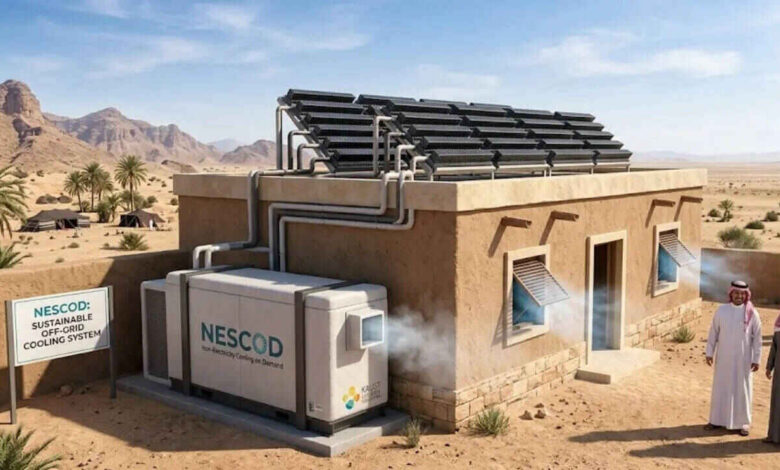
As extreme heat continues to affect several countries and electricity demand rises sharply every summer, scientists in Saudi Arabia have developed a new cooling technology that could change the future of temperature control systems. The innovation, called NESCOD, has attracted global attention because it can generate cooling without depending on conventional electricity.
The system was developed by researchers at King Abdullah University of Science and Technology. Unlike regular air conditioners, this technology does not use compressors, refrigerant gases or electric motors. Instead, it relies on a chemical process that absorbs heat from the surrounding environment and creates a cooling effect naturally.
Scientists describe NESCOD as a passive cooling system designed to work with minimal energy requirements. The technology mainly uses water, salt compounds and solar heat to produce and restore cooling capacity. Because of this approach, many experts believe it could become an important solution for regions struggling with rising temperatures and unstable electricity supply.
At the center of the system is a process known as endothermic dissolution. Researchers use a salt called ammonium nitrate and mix it with water. When the salt dissolves, it absorbs heat from the nearby surroundings, causing the temperature to drop rapidly. During laboratory testing, scientists observed temperatures falling from nearly 25 degrees Celsius to around 3.6 degrees Celsius within a short period.


One of the most remarkable features of the technology is its ability to recharge itself for repeated use. After the cooling cycle is completed, the salt and water form a solution. Researchers then use solar heat to evaporate the water, allowing the salt crystals to separate and return to their original form. This makes the system reusable and environmentally sustainable.
Although social media discussions have described NESCOD as a possible replacement for traditional air conditioners, researchers say the technology is still in its early development phase. It has not yet been tested on a large commercial scale in places such as malls, office buildings or large residential spaces. Scientists are continuing studies to understand how effectively it can cool larger areas over long durations.
Even so, experts believe the invention could prove extremely useful in remote and electricity deficient regions. Rural communities, desert locations, emergency medical storage units and small food preservation facilities may benefit significantly from such systems. The technology may also help reduce pressure on power grids during severe summer conditions.
Countries experiencing rapid temperature increases are closely watching such developments. In nations where electricity consumption rises sharply during heatwaves, alternatives that reduce dependence on continuous power supply are becoming increasingly important. Researchers say innovations like NESCOD could eventually support more sustainable and affordable cooling solutions in the future.
The growing interest around this Saudi research reflects a larger global concern about climate change and energy usage. While conventional air conditioning remains essential for millions of people, scientists worldwide are searching for cleaner and more energy efficient technologies that can provide relief from rising heat without increasing environmental pressure.