
AI Powered Fingerprint Theft Threat Raises Concerns Over Social Media Selfies
Cybersecurity experts warn that advanced AI tools can now extract fingerprint details from selfies, increasing risks of identity theft, financial fraud and misuse of sensitive biometric information online.
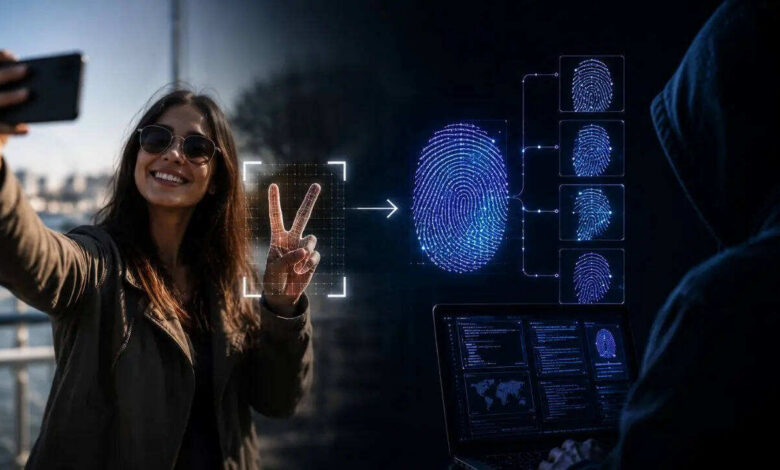
Posting selfies on social media may now carry a hidden cybersecurity risk that many users have never considered before. Security researchers are warning that advanced artificial intelligence tools are becoming capable of extracting fingerprint details directly from ordinary photographs shared online.
The concern has gained attention after cybersecurity experts demonstrated how high resolution selfies could reveal enough fingerprint information to create serious privacy and security risks. What once looked like a harmless peace sign pose in front of the camera is now being discussed as a potential gateway to biometric data theft.
According to reports, the issue recently came into focus after security expert Li Chang demonstrated the technology during a Chinese workplace reality show. During the demonstration, a celebrity selfie featuring a peace sign gesture was reportedly used to show how fingerprint patterns can sometimes be captured clearly enough for digital analysis.
Researchers explain that if fingers are positioned directly toward the camera and the image is taken from close range, fingerprint details may become visible in modern smartphone photographs. Even images taken from distances of up to three meters may still reveal partial fingerprint patterns depending on camera quality and image resolution.


What makes the situation more alarming is the role of AI enhancement technology. Experts say modern AI tools can sharpen blurry images, improve hidden details and reconstruct fingerprint patterns that may not appear visible to the human eye at first glance.
This means that simple social media uploads such as concert selfies, travel photos or stadium pictures could unknowingly expose sensitive biometric information. Many users share high quality images publicly without realizing that their fingerprints may also be visible in those photographs.
Cybersecurity researchers believe biometric theft poses a far greater long term danger than ordinary password leaks. Passwords can usually be changed within minutes, but fingerprints remain permanent throughout a person’s life. If fingerprint data is stolen and misused, the consequences may become difficult or impossible to fully reverse.
Experts warn that leaked biometric information could eventually be used for identity theft, unauthorized access or even financial fraud. As more smartphones, banking applications, workplaces and airports rely on fingerprint authentication systems, the importance of protecting biometric data has increased significantly.
The growing sophistication of AI powered image analysis tools has added another layer of concern. What previously required expensive forensic technology can now potentially be done using commercially available AI enhancement software and advanced image processing systems.
Despite the warnings, security professionals are not advising people to stop taking photos completely. Instead, they are encouraging users to become more cautious while sharing high resolution close up images online.
Simple habits can help reduce the risk considerably. Experts suggest avoiding poses where fingertips directly face the camera, lowering image quality before uploading public photos and being more careful with extreme close range selfies.
The issue highlights how rapidly advancing artificial intelligence is changing the cybersecurity landscape. Technology that once seemed useful only for photography enhancement is now raising new questions about digital privacy and personal safety in everyday online activities.
For millions of social media users, the warning serves as a reminder that even casual online behavior can sometimes reveal more personal information than expected.