

Revanth Reddy Warns of Public Agitation Over Lok Sabha Seat Increase Proposal
Revanth Reddy opposes Lok Sabha seat increase, warns imbalance between states, demands GDP based allocation, and cautions that ignoring consensus may trigger nationwide public agitation and political unrest.
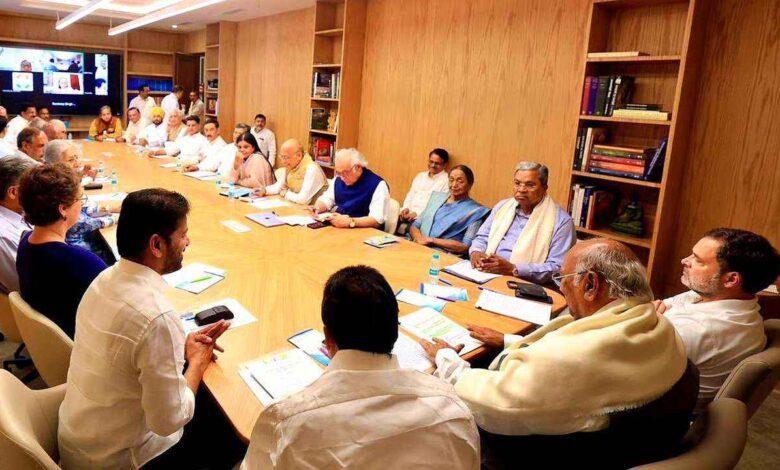
- Revanth Reddy warns Lok Sabha seat increase may trigger public agitation
- Lok Sabha seat increase could widen imbalance between north and south states
- Revanth Reddy demands GDP based allocation for Lok Sabha seat increase
Telangana Chief Minister Revanth Reddy has strongly opposed the central government’s proposal to increase Lok Sabha seats by 50 percent, warning that such a move could disturb the balance among states and lead to widespread public agitation.
Speaking in Delhi during his visit for a Congress Working Committee meeting, Revanth Reddy expressed concern that the proposal, if implemented without broader consultation, would deepen regional disparities. He stated that ignoring the voices of various political parties and states could provoke strong public reactions across the country.
He argued that the increase in parliamentary constituencies should not be done blindly, but instead must consider economic, social, and political factors. According to him, allocating seats purely based on population would disproportionately benefit larger northern states while making smaller and southern states politically weaker.
Revanth Reddy emphasized that states contributing significantly to the country’s economy, particularly in southern and western India, deserve fair representation. He suggested that seat allocation should be based on Gross Domestic Product, ensuring that economically strong states receive proportionate representation in Parliament.

He further pointed out that the issue is not limited to southern states alone. Several northern states such as Punjab, Haryana, Uttarakhand, Himachal Pradesh, Chhattisgarh, and Jharkhand could also face disadvantages if the proposal is implemented without balance.
Drawing a comparison with past events, he recalled how the central government had to repeal controversial farm laws following nationwide protests. He warned that a similar situation could arise again if the government proceeds unilaterally on this issue.
The Chief Minister also raised concerns about growing financial and political imbalances, noting that certain states receive a disproportionately higher share of central funds. Increasing seats, he said, would further strengthen already dominant states politically.
He cautioned that if the proposal is enforced without consensus, future governments could be formed without meaningful participation from southern states, with political power concentrated in a few large northern states.
On the issue of women’s reservation, Revanth Reddy clarified that the Congress party supports it but questioned the intent behind linking it to seat expansion. He argued that reservations could be implemented within the existing 543 seats if there was genuine commitment.
He also questioned the urgency behind the proposal, suggesting that constituency delimitation should ideally take place only after the completion of the next population census. With current technology, he noted, census data collection could be completed within months, making it reasonable to wait.
In a political counterattack, Revanth Reddy criticized Bharat Rashtra Samithi leaders, including K. T. Rama Rao, accusing them of hypocrisy regarding party loyalty and treatment of senior leaders. He highlighted instances where leaders were sidelined or ignored after electoral defeats.
Highlighting the numerical impact of the proposal, he explained that states like Uttar Pradesh could see a significant rise in seats, increasing the gap between northern and southern representation. This, he warned, would tilt the political balance further in favor of a few large states.
Revanth Reddy concluded that any unilateral decision on increasing Lok Sabha seats would not only create political imbalance but could also trigger a powerful public movement, urging the central government to adopt a more inclusive and balanced approach.


