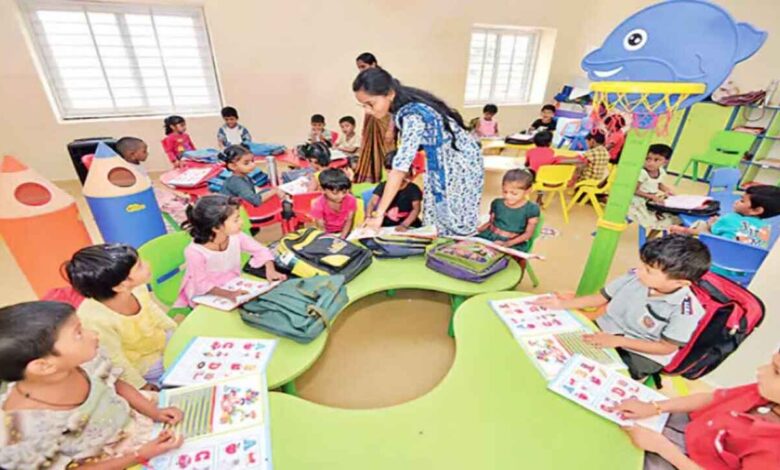
In a significant step toward strengthening early education, the Telangana government has decided to expand UKG classes in government schools across the state. Following the success of the pilot program, authorities are now preparing for a wider rollout that is expected to benefit thousands of students and create employment opportunities.
The initiative, which began in select schools last academic year, has shown encouraging results. Around 1000 government schools had already introduced UKG under pre primary teaching, prompting the government to scale up the program further. Plans are now in place to extend these classes to nearly 3000 more schools in the coming academic years.
Officials from the School Education Department have been directed to identify institutions where pre primary classes are most needed. District Education Officers have been asked to submit detailed reports to facilitate smooth implementation. With this expansion, nearly 6000 temporary jobs are expected to be generated, including instructors and support staff.
The government aims to ensure that public schools offer facilities comparable to private institutions. As part of this vision, efforts are underway to introduce structured pre primary education that includes UKG, with growing demand from parents to also add nursery and LKG classes in the future.
Currently, over 1300 schools in Telangana are already running UKG classes, with appointed instructors and helpers receiving monthly honorariums. These positions are funded under the Samagra Shiksha program, supporting the broader goal of improving foundational learning.
Looking ahead, the government plans to implement pre primary education in at least one school in each gram panchayat. Additionally, in the Hyderabad Core Urban Region, authorities are working to establish integrated education campuses offering classes from pre primary to intermediate level.
This expansion reflects the government’s commitment to making quality education accessible to all while also generating employment and reducing dependence on private schooling for early education.